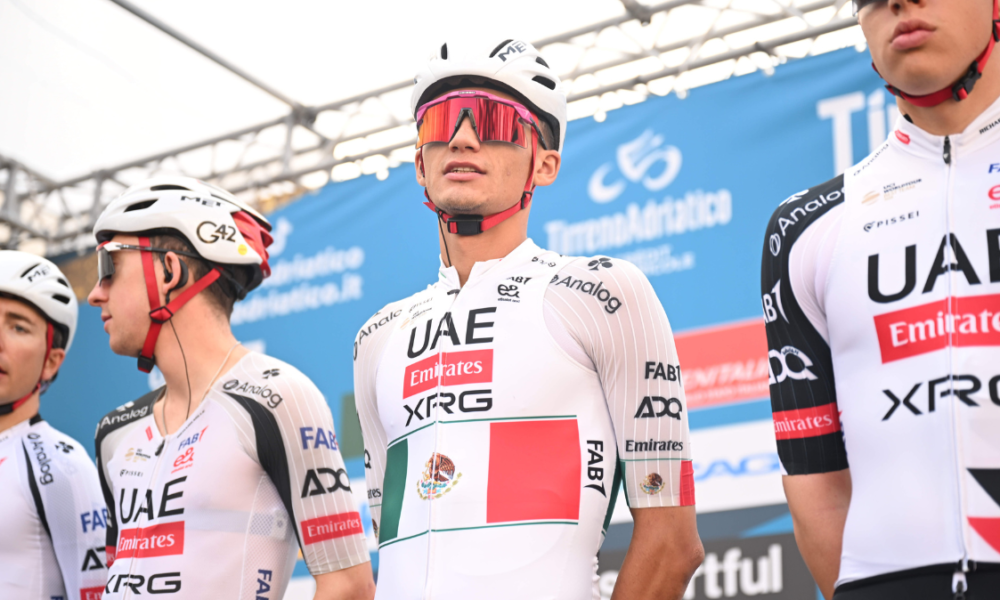
Led by Isaac Del Toro, Mexican cycling had never had such fertile ground
ROAD CYCLING 2026 – Long relegated to one-man performances, Mexican cycling may finally take off.
On the road to Épinal, in the summer of 1990, a Mexican cyclist made headlines. So at its peak, Raul Alcala wins a time trial over 60km at the Tour de France, ahead of a certain runner-up Miguel Indurainone minute and 24 seconds. The rider from the Dutch PDM team had already won an online stage the previous year and his consistency in the mountains allowed him to score three top 10s in the general classification.
What can generate vocations in the Central American country? Not really, since we had to wait until the 2000s, more than a decade later, to see other Mexican racers shine. Julio Alberto Pérez Cuapio then he came out of nowhere to win three stages of the Giro d’Italia in 2001 and 2002. A formidable climber, both on the run and on the pedal, he also won the best climber jersey in 2002.
📊🏆🇲🇽 Stage winners of the Grand Tour
3 — Julio Perez Cuapio
2 — Alcala River
1 — Isacco del Toro🇮🇹#Tour
— professional cycling (@ammattipyoraily) May 28, 2025
More than twenty years of famine!
Raul Alcala, Julio Alberto Pérez Cuapio or late Miguel Arroyo : many profiles of typical stage race riders. There were also many cyclists who could have created a dynamic and brought out many gems in the country. However, this was not the case. Indeed, Mexico experienced a period of weakness of about twenty years after the performance of its little climber. Nothing to eat, no famous runners.
The country had to make do with knights with the pedigree ofEfren Santosenough to compete in dark and sulphurous races on the American calendar, such as the Tour of Costa Rica, and without the slightest adventure in the Old Continent.
Isaac Del Toro finally creates the emulation
Then, the emergence of a real crack, leader of world cycling, third in the UCI ranking in 2025, is changing the situation. Indeed, Isacco Del Toro He literally glossed over the previous season, with 18 victories and great performances, particularly in the Giro d’Italia. The UAE Team Emirates XRG rider has also made a strong start to 2026, putting himself forward Tirreno-Adriatico.

Isaac Del Toro’s demonstration! Stronger than everyone, the Mexican resisted the attacks and won the 6th stage of the Tirreno-Adriatico 👑 pic.twitter.com/3MRTCNKlt5
— Eurosport France (@Eurosport_FR) March 14, 2026
In its wake, careers may finally reveal themselves and vocations be born. Thus, a small group of names begins to emerge in the sector and, although it remains discreet for the moment, we have never seen so many Mexican cyclists at the same time on the European circuit. The most significant example is that ofEdgar David Cadena. The Team Storck – MRW Bau rider, among other things, stood out at the Tour of Asturias, revealing the qualities of a true puncher and winning two stages.

Evidence of a new diversity of profiles in the country, the sprinter Cesare Macias he also recently started his career in Europe. Among the Spaniards of Burgos Burpellet BH, he is still in the running-in phase but is starting to show his speed, especially taking third place in a stage of the Tour of Turkey. Behind him, the young Mexican also shows promise. Take twin brothers for example. José Antonio Prieto et Jose Juan Prietofor the moment at Petrolike, or even at Wheeler Sebastiano Ruiz.
Racers showing off and the best behind the scenes
This therefore bodes well for a country that saw its national championships played last October, after four years of absence due to exclusion by theUCI by the local cycling federation for “serious organizational problems” in May 2022.
The international federation having finally recognized theCycling Union of Mexico as a new local body, founded following the changes that occurred within the central government and, consequently, the National Commission for Physical Culture and Sport (CONADE), responsible for the various sports organisations. To the delight of cycling enthusiasts in Mexico.
PakarPBN
A Private Blog Network (PBN) is a collection of websites that are controlled by a single individual or organization and used primarily to build backlinks to a “money site” in order to influence its ranking in search engines such as Google. The core idea behind a PBN is based on the importance of backlinks in Google’s ranking algorithm. Since Google views backlinks as signals of authority and trust, some website owners attempt to artificially create these signals through a controlled network of sites.
In a typical PBN setup, the owner acquires expired or aged domains that already have existing authority, backlinks, and history. These domains are rebuilt with new content and hosted separately, often using different IP addresses, hosting providers, themes, and ownership details to make them appear unrelated. Within the content published on these sites, links are strategically placed that point to the main website the owner wants to rank higher. By doing this, the owner attempts to pass link equity (also known as “link juice”) from the PBN sites to the target website.
The purpose of a PBN is to give the impression that the target website is naturally earning links from multiple independent sources. If done effectively, this can temporarily improve keyword rankings, increase organic visibility, and drive more traffic from search results.